
01The concept
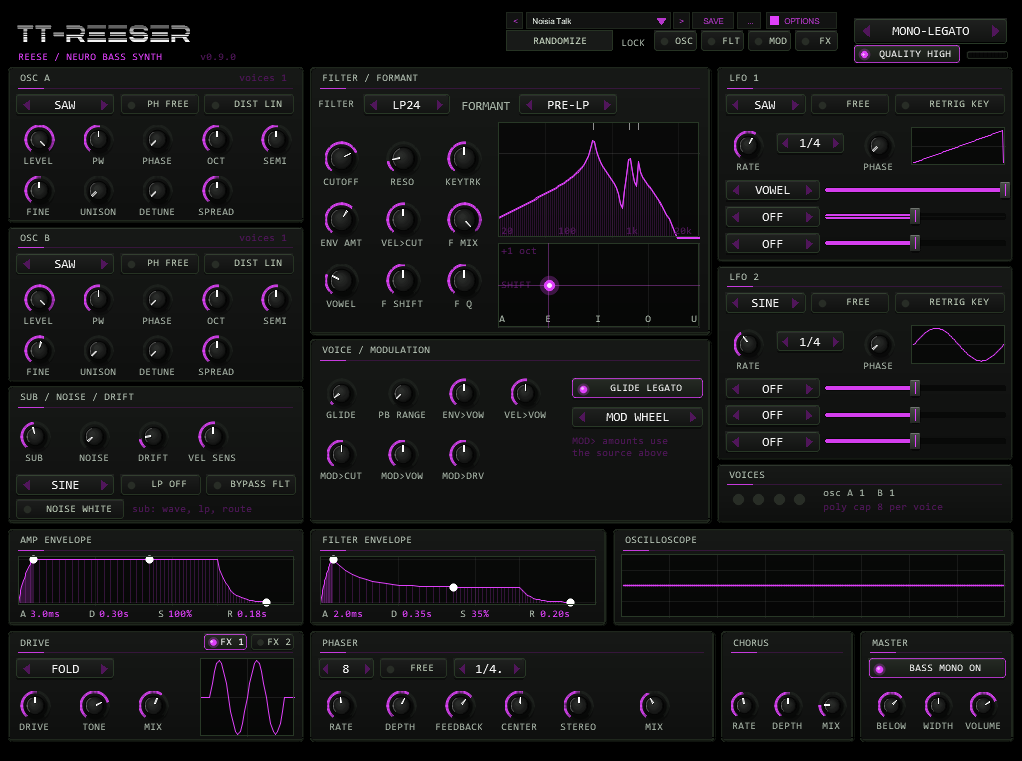
A Reese bass is two sawtooth oscillators, a few cents apart, through a low-pass: the slow beating between them is the sound. Modern neuro, DnB, speed garage and dark techno basses grow from that seed — more voices, drifting pitch, a talking (formant) filter, moving phasers, echoes and space, and a stereo image that stays mono where the sub lives. TT-REESER puts all of that in one JSFX instrument:
- Oscillators A / B — saw, square/PWM, triangle, sine or reese-saw, each with 1-7 unison voices, detune, spread and a shared analog-style drift; plus sub and noise.
- Mono-legato with glide (the bass default) or 4-voice poly.
- 4-pole ladder filter (LP12 / LP24 / BP / HP) and a vowel formant filter (three resonant band-passes moving over A-E-I-O-U) — in front of, behind or parallel to it.
- 2 LFOs (free or tempo-synced), amp and filter envelopes, mod wheel and aftertouch.
- Drive, phaser, chorus, bass mono and width, then a tempo-synced ping-pong delay and a reverb, then a soft limiter.
- 57 factory presets in twelve families, randomize with lockable groups.
02Sound examples
21 short phrases, each played with one factory preset as it ships — no edits, no extra effects, no mastering beyond a common loudness. The number in the chips is the preset number in the FACTORY list; the tempo is the one the delay and LFO sync follow. Filter by style, click a row to play it, click or drag the waveform to jump (the faint lines mark the bars). With AUTO on, the next example follows.
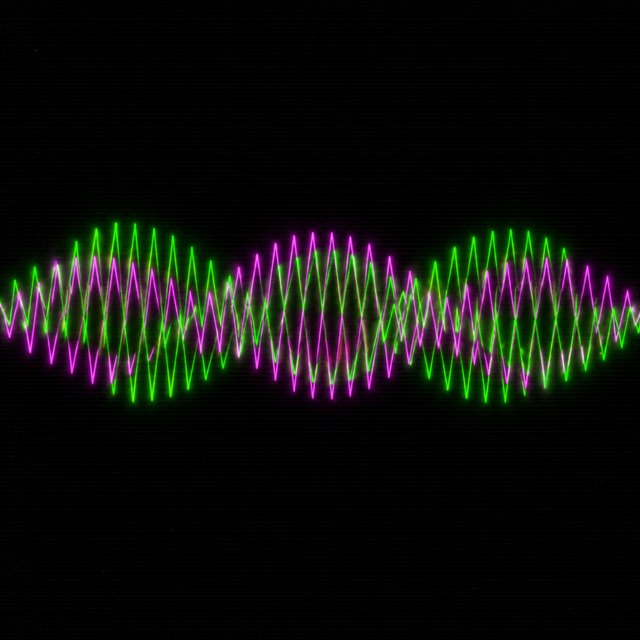
Five voices per oscillator, 1/8 ping-pong delay, short hall
03Quick start
- Insert
TT-REESERon a track (REAPER 7.x). It is an instrument: it has no audio input and generates sound from MIDI. - Play notes around C1-C3. The INIT program is a single saw through an open filter.
- Pick a program with the preset bar in the header (arrows, or click the name for the list) — for example
Classic Reese,Wobble 1/8orNoisia Talk. - Turn CUTOFF, drag the dot in the vowel pad (left-right = vowel, up-down = formant shift), pull the LFO amount sliders.
- Automate anything: the first 57 parameters are host-automatable (section 13); everything is stored with the project and in REAPER presets.
Shift = fine, mouse wheel = step,
double-click / right-click / Ctrl+click = default value. Combos: arrows step, click on the middle cycles,
right-click goes back. Hover a control for a tooltip with the name and value.04Oscillators, unison, sub
Both oscillators share the same controls. WAVE: SAW, SQUARE (pulse width PW 5-95 %, also the
LFO PWM target), TRI, SINE and REESE-SAW (a saw with a 5 % symmetry shift: the falling edge becomes a
short ramp). OCT -2...+2, SEMI -12...+12 and FINE +-100 ct tune each oscillator; the classic Reese
is A and B on SAW with B FINE at +5...+15 ct. The beat frequency is f * (2^(cent/1200) - 1):
7 ct at 55 Hz beats at 0.2228 Hz.
Unison, detune, spread
UNISON 1-7 voices per oscillator spread over +-DETUNE cents (button DIST: LIN evenly, EXP
clustered towards the middle). SPREAD pans the voices across the stereo field (oscillator B mirrored against
A). Each unison voice is scaled by 1/sqrt(n). PH chooses the start phase: FREE (random, analog) or
RESET (all voices start at PHASE degrees — identical, punchy attacks).
voices 4).Drift, sub, noise
- DRIFT adds a slow random pitch wander (up to +-10 ct at 100 %) that is independent for every unison voice but shared by A and B of that voice — so the Reese beat stays exact while the pitch lives. Measured: beat 0.2230 Hz with DRIFT 100 %, pitch wander +-9 ct.
- SUB is a sine (or TRI / SQUARE) one octave below the played note. LP puts a 200 Hz low-pass on it, the routing button sends it around (BYPASS FLT) or through the filter (THRU FLT).
- NOISE is white or pink and always runs through the filter — good for dirt, breath and for measuring filters.
Quality
QUALITY HIGH renders the oscillators at twice the sample rate with 4-point PolyBLEP corrections and a 48-tap FIR decimator: a saw at C6 (1046 Hz, 48 kHz) has its strongest non-harmonic component at -93 dBc. DRAFT runs at the base rate (still 4-point PolyBLEP, -43.5 dBc at C6) and saves roughly a quarter of the CPU (measured with unison 7 + 7) — an emergency switch for huge projects; low bass notes alias far less than notes near C6.
05Voices, glide, MIDI
| MODE | Behaviour |
|---|---|
| MONO-LEGATO | One voice. Overlapping notes are bound: the pitch glides to the new note and the envelopes are not restarted (no click: measured max step 0.004 FS). Releasing the newer note while the older is held returns to the older note (note stack, last-note priority). Detached notes retrigger. |
| POLY 4 | Four voices, round-robin allocation. A fifth note steals the oldest gated voice (voices already in release are taken first). Unison is reduced to 8 oscillators per voice. |
GLIDE 0-2 s glides exponentially in pitch: after the GLIDE time 63 % of the pitch distance (in cents) is covered — measured 0.501 s for GLIDE 0.5 s. GLIDE LEGATO glides only between bound notes, GLIDE ALWAYS also from the previous note into a detached one. Glide is a MONO feature.
- Pitch bend +-2...12 semitones (PB RANGE).
- Velocity: VEL SENS scales the level (100 % = linear with velocity), VEL>CUT and VEL>VOW steer cutoff and vowel.
- Mod wheel (CC1) and aftertouch (channel pressure or poly pressure): choose the source with MOD SOURCE (wheel, aftertouch, both = maximum); the amounts MOD>CUT / MOD>VOW / MOD>DRV route it.
- CC123 (All Notes Off) releases every voice, CC120 (All Sound Off) silences immediately. Stopping the transport releases held notes; starting the transport from stop resets all voices and effect tails.
06Filter
A four-pole ladder in zero-delay-feedback form. The resonance loop is solved without delay
(y4 = (G^4 x + B) / (1 + G^4 k)) and limited by the signal level
(k_eff = k / (1 + 0.4 |y4|), the principle of the TT-303 filter) so a high RESO growls instead of
exploding.
| Type | Output | Slope | CUTOFF means |
|---|---|---|---|
| LP24 | 4th stage | 24 dB/oct | -3 dB point at RESO 0, resonance peak at RESO 100 % |
| LP12 | 2nd stage | 12 dB/oct | -3 dB point |
| BP | stages 1-3 difference | 12 dB/oct each side | centre (geometric mean of the -3 dB points) |
| HP | 4th-order high-pass | 24 dB/oct | -3 dB point |
CUTOFF 20 Hz-18 kHz (log). KEYTRK makes the cutoff follow the note (100 % = one octave per octave,
reference C4). ENV AMT +-100 % moves the cutoff by up to +-6 octaves with the filter ADSR;
VEL>CUT, LFOs and mod wheel add to it. RESO 0-100 % feeds back up to k = 4 (self-oscillation);
passband level is partly compensated (sqrt(1+k)).
07Formant filter
The formant filter is three parallel resonant band-passes at the first three formants of a vowel — the "talking bass". The vowel table (male voice):
| Vowel | F1 / F2 / F3 (Hz) | Bandwidth (Hz) | Q (F/BW) | Gain (dB) |
|---|---|---|---|---|
| A | 730 / 1090 / 2440 | 80 / 90 / 120 | 9.1 / 12.1 / 20.3 | 0 / -6 / -12 |
| E | 530 / 1840 / 2480 | 60 / 100 / 120 | 8.8 / 18.4 / 20.7 | 0 / -8 / -14 |
| I | 270 / 2290 / 3010 | 60 / 100 / 120 | 4.5 / 22.9 / 25.1 | 0 / -14 / -18 |
| O | 570 / 840 / 2410 | 70 / 80 / 100 | 8.1 / 10.5 / 24.1 | 0 / -6 / -14 |
| U | 300 / 870 / 2240 | 40 / 80 / 100 | 7.5 / 10.9 / 22.4 | 0 / -8 / -16 |
VOWEL 0-4 walks the table A-E-I-O-U linearly (frequencies, Q and gain are interpolated: VOWEL 0.5 = 630 / 1465 / 2460 Hz, measured 632 / 1463 / 2478). F SHIFT moves all three formants +-1 octave, F Q scales the Q by +-1.5 octaves around the table (50 % = the table values, narrow enough to articulate), F MIX blends the formant sound with the signal. FORMANT position:
- PRE-LP — formants first, the ladder filters the vowel (classic neuro growl).
- POST-LP — the ladder first, the vowel shapes what is left.
- PARALLEL — vowel and low-pass side by side, added.
At F MIX 0 the stage is skipped completely (bit-identical output, no cost). The vowel pad shows and edits VOWEL (horizontal) and F SHIFT (vertical); right-click resets both. The frequency response display is calculated from the current filter and formant settings (without modulation). VOWEL is modulatable by the filter envelope (ENV>VOW), velocity (VEL>VOW), mod wheel (MOD>VOW) and both LFOs.
08Modulation
LFO 1 / LFO 2
Shapes SINE, TRI, SAW, SQUARE, S&H. RATE 0.05-30 Hz free, or SYNC to the host tempo with these divisions:
| Division | Beats (quarters) | Rate |
|---|---|---|
| 1/32 | 0.125 | 16 Hz at 120 BPM |
| 1/16T | 0.1667 | 12 Hz at 120 BPM |
| 1/16 | 0.25 | 8 Hz at 120 BPM |
| 1/8T | 0.3333 | 6 Hz at 120 BPM |
| 1/8 | 0.5 | 4 Hz at 120 BPM |
| 1/4T | 0.6667 | 3 Hz at 120 BPM |
| 1/8. | 0.75 | 2.667 Hz at 120 BPM |
| 1/4 | 1 | 2 Hz at 120 BPM |
| 1/2T | 1.333 | 1.5 Hz at 120 BPM |
| 1/4. | 1.5 | 1.333 Hz at 120 BPM |
| 1/2 | 2 | 1 Hz at 120 BPM |
| 1/2. | 3 | 0.6667 Hz at 120 BPM |
| 1/1 | 4 | 0.5 Hz at 120 BPM |
| 2/1 | 8 | 0.25 Hz at 120 BPM |
| 4/1 | 16 | 0.125 Hz at 120 BPM |
| 8/1 | 32 | 0.0625 Hz at 120 BPM |
PHASE shifts the start. RETRIG KEY restarts the LFO with every new (non-bound) note; FREE runs on — with SYNC it is locked to the timeline position, drift-free. Each LFO has three destinations with a bipolar amount:
| Destination | 100 % amount |
|---|---|
| PITCH | +-12 semitones (vibrato, sirens) |
| DETUNE | +-50 ct added to both detune values (beating that breathes) |
| CUTOFF | +-4 octaves |
| RESO | +-50 % |
| VOWEL | +-2 table steps |
| PHASER | +-2 octaves on the phaser sweep centre |
| PWM | +-45 % pulse width |
| AMP | tremolo, full depth at 100 % (gain 0...1) |
| DRIVE | +-50 % drive amount |
Envelopes
Amp and filter ADSR: 0.5 ms-5 s, exponential curves. Attack aims at 1.3 so it reaches full level after exactly the displayed time; decay and release reach 1 % of their target in the displayed time. Drag the nodes in the editor (attack node = A, decay node = D and S, release node = R); right-click a node resets it. A new attack starts from the current level, so fast retriggers never click.
09Effects & bass mono
Fixed order: voices - drive - phaser - chorus - bass mono / width - delay - reverb - volume - soft limiter. The FX row of the front has two pages (buttons FX 1 / FX 2 in the title bar of the left panel): FX 1 = drive, phaser, chorus; FX 2 = delay, reverb. MASTER is visible on both.
Drive
Types SOFT (tanh), TUBE (asymmetric), FUZZ (exponential) and FOLD (sine wavefolder, input limited to +-4 so it can never blow up). DRIVE 0-40 dB pre-gain, TONE low-passes the wet signal (800 Hz-18 kHz), MIX blends parallel. The shaper runs 2x oversampled and each type is level-normalised. DRIVE 0 (and MIX 0) is an exact bypass: the output is bit-identical to a chain without the stage. The curve display shows the transfer function.
Phaser
4, 6 or 8 first-order all-pass stages per channel, sweep centre CENTER 100-5000 Hz, DEPTH in octaves
(100 % = +-2 oct), FEEDBACK +-95 %, free rate or tempo sync, STEREO offsets the right channel's LFO up to
180 degrees. The output is in + MIX * 0.5 * (allpass - in): at MIX 100 % you get the classic notch pattern
(8 stages = 4 notches). Measured with 8 stages, FEEDBACK 0.5: notch depth 16-19 dB, notch positions within
tolerance of the analytic model at CENTER 2 kHz (412 / 1360 / 3049 Hz) and 200 Hz (124 / 288 / 1030 Hz), the sweep
follows CENTER x 2^(+-DEPTH) (ratio 10.6-11 for 200 Hz - 2 kHz).
Chorus
Two modulated delay taps per channel (15 / 19 ms centre, up to +-4 ms), right LFO 90 degrees behind: RATE, DEPTH, MIX. MIX 0 is an exact bypass.
Delay
Stereo delay after the bass mono stage, so a mono bass is echoed in mono. SYNC switches between a free time (TIME 1-1500 ms) and a tempo division (DIV: 1/32, 1/16T, 1/16, 1/8T, 1/8, 1/4T, 1/8., 1/4, 1/2T, 1/4., 1/2, 1/2.; host tempo, 120 BPM when the host reports none; times above 2.5 s are limited). PING-PONG feeds the mono sum into the left line and bounces the repeats left - right - left. FEEDBACK 0-95 %. Inside the feedback loop each repeat passes a LOW CUT (20-400 Hz, one pole; keeps the bass out of the repeats), a HIGH CUT (1-16 kHz, one pole) and the SATURATION (0-100 %, tanh, unity gain for small signals; at 0 % a transparent soft clip). The loop can never build up: the feedback path is always limited, so 95 % feedback with a steady signal settles at a fixed level. DUCK lowers the delay signal while the dry bass plays (envelope follower, 5 ms attack / 200 ms release; at 100 % the repeats are silent above roughly -16 dBFS dry level) so the bassline stays clear. MIX adds the delay signal to the dry signal (0-100 %). Changing TIME or the tempo moves the read pointer smoothly (at most 0.3 samples per sample, tape-like pitch sweep, no clicks). MIX 0 is an exact bypass; the buffers are cleared once when the delay is switched off.
Reverb
A feedback delay network (FDN): the input passes a low cut and the pre-delay, then feeds eight delay lines (31-88 ms, scaled by SIZE and by the sample rate). Each line has its own damping low-pass and a gain set from DECAY so that the level falls by 60 dB after DECAY seconds; the lines are coupled by an orthogonal Householder matrix (no energy is lost in the mixing) and a very slow modulation (about 0.35 ms) breaks up metallic ringing. Even lines make up the left, odd lines the right output. SIZE 0-100 % scales the line lengths (0.4 - 1.6 x), DECAY 0.2-10 s (this is the low-frequency decay time; with DAMPING above 0 the highs die sooner, and measured RT60 comes out about 10-15 % below DECAY even at DAMPING 0), PRE-DELAY 0-200 ms, DAMPING (highs decay faster; 0 = none, 100 % = 1.2 kHz), LOW CUT 20-600 Hz (default 150 Hz) on the reverb input so the bass does not turn into mud, WIDTH 0-100 % (0 = mono), MIX adds the reverb to the dry signal. The input level is compensated so that the total reverb energy does not depend on DECAY. MIX 0 is an exact bypass (buffers cleared once).
Tails. Delay and reverb keep running when the voices are silent: the repeats and the reverb tail ring out after note-off and after the transport stops. Starting the transport from stop (and a sample-rate change) clears them. QUALITY DRAFT makes the reverb cheaper: 4 instead of 8 lines and no modulation; the delay is unchanged (it is cheap).
Bass mono and width
BASS MONO keeps everything below MONO BELOW (20-300 Hz, default 120 Hz) in the centre. The signal is split
into mid M = (L+R)/2 and side S = (L-R)/2; only S passes a 4th-order Butterworth
high-pass; then L = M + S*WIDTH, R = M - S*WIDTH. The mid signal is never touched.
WIDTH 0-200 % scales the side signal (0 = mono, exactly L = R). Measured: S at 0.34 x the corner
frequency (41 Hz vs 120 Hz) is -36.7 dB, at 0.69 x -12.9 dB, above 2.7 x the corner 0.00 dB (the
specification asked for -20 dB at one third of the corner, a 2nd-order high-pass would give only -19.3 dB).
Master
VOLUME -30...+6 dB, then a soft limiter (linear up to 0.7 FS, tanh knee, hard ceiling 1.0) with NaN/Inf protection. The oscilloscope shows the mono sum, triggered on a rising zero crossing.
10Preset bar, user bank & randomize
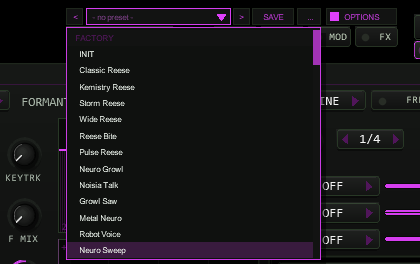
OPTIONS: < name > SAVE .... The name opens the list with the FACTORY and USER sections.57 factory programs plus INIT (single saw, open filter) form the FACTORY list (INIT is its first entry). All are loudness-matched (about -14 dBFS RMS on A1) so you can browse without touching the fader. A program sets every parameter — it does not stack on the previous one. Loading INIT resets everything, also when INIT is already selected.
| Family | Programs |
|---|---|
| Classic Reese | Classic Reese, Kemistry Reese, Storm Reese, Wide Reese, Reese Bite, Pulse Reese |
| Neuro / Growl | Neuro Growl, Noisia Talk, Growl Saw, Metal Neuro, Robot Voice, Neuro Sweep |
| Speed Garage / 2-Step | 2-Step Wobble, Garage Stab Bass, Speed Garage Sub, UKG Reese, Bounce Bass |
| Vowel / Talking | Vowel Bass A-E, Talking I-O, U Bass Hum, Formant Wobble, Vocal Growl, Mod Wheel Vowel |
| Dark Techno Reese | Dark Reese, Rumble Reese, Industrial Grit, Hypno Reese, Warehouse Bass |
| Sub-Reese | Sub Reese, Deep Sub Layer, Sine Weight, Low Beat |
| Wobble 1/4 + 1/8 | Wobble 1/4, Wobble 1/8, Wobble 1/8 Tri, Wobble 1/8 Dotted, Half-Time Wobble, Wobble Growl |
| Detroit / Foghorn | Foghorn, Detroit Reese, Motor City |
| Stab (poly) | Reese Stab, Poly Stab, Neuro Stab |
| Pad-Reese | Reese Pad, Wide Drone, Choir Pad |
| FX programs (delay / reverb, v0.7.0) | Dub Reese, Neuro Hall, Speed Garage Echo, Cathedral Pad Bass, Tape Sub Echo, Dark Techno Room, Jungle Spring Stab, Vowel Cave, Widescreen Reese |
| House organ | House Organ |
New: House Organ, a 90s house organ bass. A triangle carries the body, a sine a fifth two octaves above it rings like a bell and fades through the filter envelope while the body sustains; both oscillators restart in phase, which gives the short key click. Play it around C2.
Triangle plus a decaying sine bell: 90s house organ bass
The bar loads and saves the whole sound of the instance in one step: all 123 sound parameters, including the ones that have no slider (LFO shapes and destinations,
delay and reverb, quality, and so on) and the output volume. Not part of a preset: the colour scheme (OPTIONS), the FX page (FX 1 / FX 2), the randomize locks and the program number that the hidden
PRESET parameter carries for automation.
| Control | Function |
|---|---|
< / > | Previous / next preset: first INIT and the 57 factory programs, then the used user slots; wraps around and loads immediately. |
| Name field | Opens the list: FACTORY (58 entries) and USER (32 slots, empty ones show - empty -). Mouse wheel scrolls, click loads. A * behind the name means the sound differs from the loaded preset. |
SAVE | Saves the current sound into the selected user slot; with a factory preset (or none) selected, into the first free slot. A name box opens (up to 24 characters, default User 07): type, Enter or OK saves, CANCEL or a click outside cancels. |
... | RENAME, COPY (into the next free slot) and DELETE (a second click confirms) for the selected user preset. |
Where the user bank lives. Plug-ins cannot write files, so the 32 user slots are part of the plug-in state: they are saved with the project, with FX-chain and track-template copies,
and in every REAPER preset of this plug-in (the + button in the FX window toolbar). To take your bank to another project or computer, save a REAPER preset once
(+ → Save preset) and load it there: the whole bank comes with it. Projects saved with earlier versions (0.6 to 0.8) load unchanged with an empty bank.
Typing names. REAPER keeps Space for the transport, so type Shift+Space for a blank. Depending on your REAPER settings Esc closes the whole FX window; use CANCEL instead. (The + menu of the FX window also has Send all keyboard input to plug-in.)
RANDOMIZE (second header row, left of the lock keys) re-rolls four groups within musical ranges — OSC (waves, levels, unison, detune, drift, sub), FLT
(cutoff, resonance, envelope, formant), MOD (LFO shapes, rates, destinations, amounts), FX (drive, phaser, chorus; delay and reverb are left alone).
The four LOCK buttons exclude a group; amp envelope, voice mode, glide and master stay untouched. A randomized sound can be kept with SAVE.
11Front panel map
| Area | Contents |
|---|---|
| Header | Preset bar (< name > SAVE ...), OPTIONS (COLOR), RANDOMIZE + LOCK buttons, MODE (MONO-LEGATO / POLY 4), QUALITY (HIGH / DRAFT), output meter |
| OSC A / OSC B | WAVE, PH (FREE / RESET), DIST (LIN / EXP), LEVEL, PW, PHASE, OCT, SEMI, FINE, UNISON, DETUNE, SPREAD |
| SUB / NOISE / DRIFT | SUB, NOISE, DRIFT, VEL SENS, sub waveform, LP, routing, noise colour |
| FILTER / FORMANT | Filter type, formant position, CUTOFF, RESO, KEYTRK, ENV AMT, VEL>CUT, F MIX, VOWEL, F SHIFT, F Q, response display, vowel pad |
| VOICE / MODULATION | GLIDE, glide mode, PB RANGE, ENV>VOW, VEL>VOW, MOD>CUT / VOW / DRV, MOD SOURCE |
| LFO 1 / LFO 2 | Shape, SYNC, RETRIG, RATE, DIV, PHASE, preview, three destination + amount rows |
| Envelopes | Amp and filter ADSR editors (drag nodes), oscilloscope |
| FX row, page FX 1 | DRIVE (type, drive, tone, mix, curve), PHASER, CHORUS, MASTER (bass mono, width, volume) |
| FX row, page FX 2 | DELAY (SYNC, DIV, PING-PONG, TIME, FEEDBACK, LOW CUT, HIGH CUT, SATURATE, DUCK, MIX), REVERB (SIZE, DECAY, PRE-DLY, DAMPING, LOW CUT, WIDTH, MIX), MASTER. Switch pages with the FX 1 / FX 2 buttons in the title bar of the left panel |
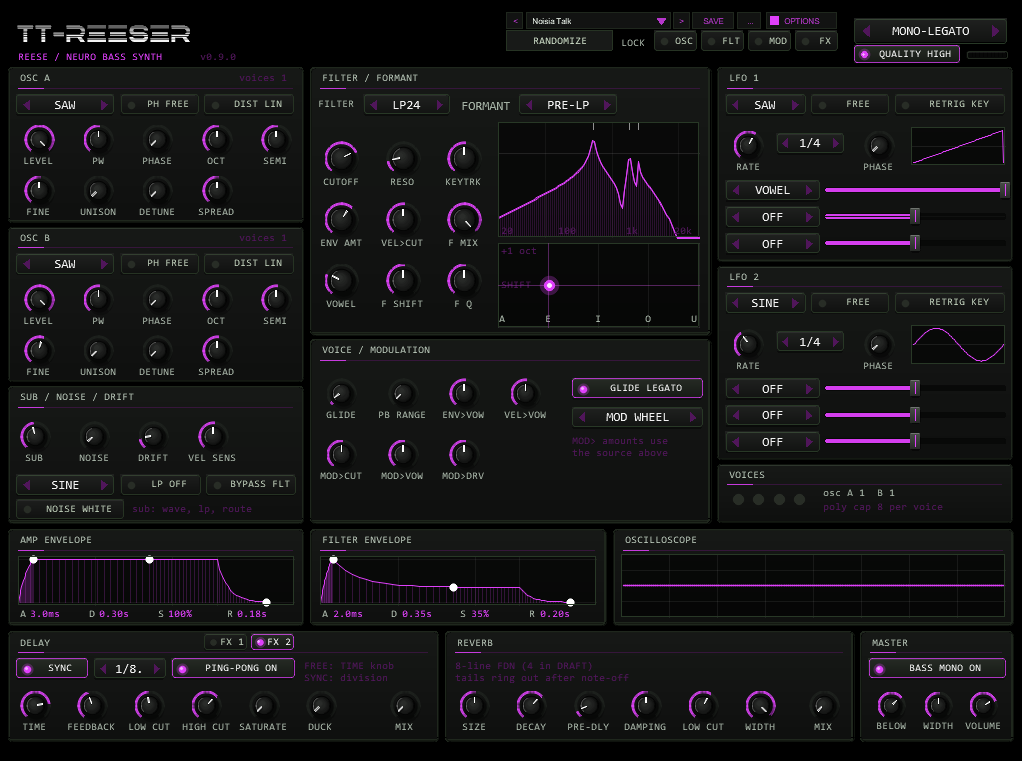
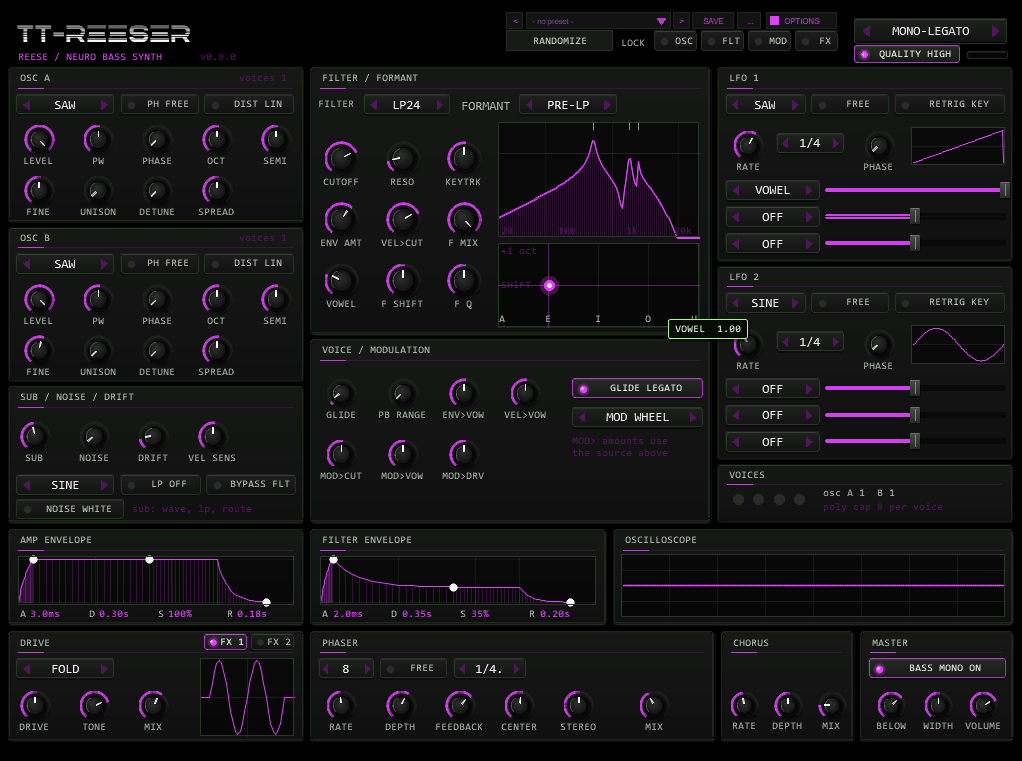
VOWEL 1.00), CUTOFF was pulled up and the response display follows immediately; the preset bar shows Noisia Talk with a star after the first change.12Options / Color
The OPTIONS button sits in the header, right of the preset bar and above the randomize lock buttons. It opens a small box with COLOR: ten colour schemes for the whole front — ACID, CYAN, ORANGE, MAGENTA, YELLOW, RED, BLUE, VIOLET, MINT and ICE. Each swatch shows the accent colour (top) and the second colour (bottom). A click on a swatch switches the front at once; the box stays open until you click the button again or click anywhere outside the box.
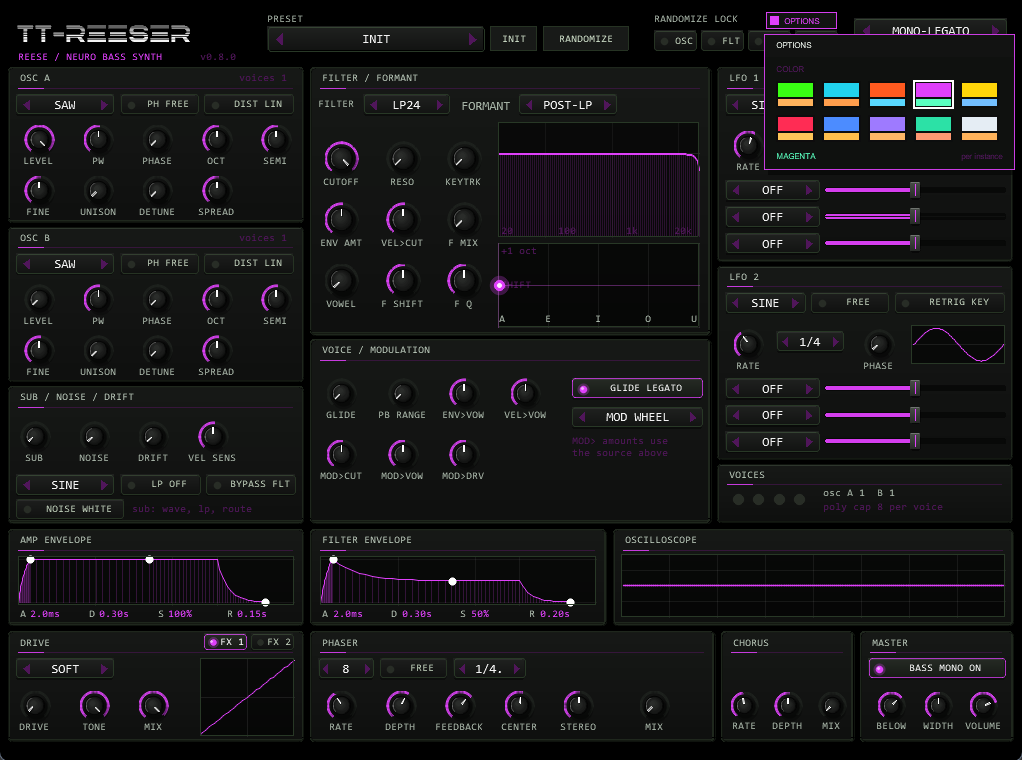
The colour is stored per plug-in instance (in the project and in the FX chain), so several instances can look different. The factory colour is MAGENTA.
It is a display setting only: it does not belong to a preset, is not touched by RANDOMIZE, and does not change the sound.
The choice is kept as the hidden slider 65 (UI Color), so it is also saved with REAPER's own FX presets.
13Automation & state
REAPER sliders are limited to 64, so the 57 most useful parameters are real (hidden) sliders — automatable,
learnable, stored in REAPER presets. All 124 parameters live in the plug-in's own model and are saved with the project
(@serialize, versioned, 32-bit floats; the user preset bank is appended behind them — a save/load round trip returns exactly the same values, tested for all
123 parameters). Slider order is fixed:
| # | Parameter | Range |
|---|---|---|
| 1 | CUTOFF | 20 ... 18000 Hz (default 18000) |
| 2 | RESO | 0 ... 100% (default 0) |
| 3 | VOWEL | 0 ... 4 (default 0) |
| 4 | F MIX | 0 ... 100% (default 0) |
| 5 | F SHIFT | -1 ... 1 oct (default 0) |
| 6 | F Q | 0 ... 100% (default 50) |
| 7 | ENV AMT | -100 ... 100% (default 0) |
| 8 | DRIVE | 0 ... 100% (default 0) |
| 9 | VOLUME | -30 ... 6 dB (default -3) |
| 10 | MODE | MONO-LEGATO / POLY 4 |
| 11 | GLIDE | 0 ... 2 s (default 0) |
| 12 | A LEVEL | 0 ... 100% (default 100) |
| 13 | B LEVEL | 0 ... 100% (default 0) |
| 14 | B FINE | -100 ... 100 ct (default 0) |
| 15 | A UNISON | 1 ... 7 (default 1) |
| 16 | B UNISON | 1 ... 7 (default 1) |
| 17 | A DETUNE | 0 ... 100 ct (default 0) |
| 18 | B DETUNE | 0 ... 100 ct (default 0) |
| 19 | A SPREAD | 0 ... 100% (default 50) |
| 20 | B SPREAD | 0 ... 100% (default 50) |
| 21 | SUB LEVEL | 0 ... 100% (default 0) |
| 22 | NOISE LEVEL | 0 ... 100% (default 0) |
| 23 | DRIFT | 0 ... 100% (default 0) |
| 24 | AMP ATTACK | 0.0005 ... 5 s (default 0.0020) |
| 25 | AMP DECAY | 0.0005 ... 5 s (default 0.3) |
| 26 | AMP SUSTAIN | 0 ... 100% (default 100) |
| 27 | AMP RELEASE | 0.0005 ... 5 s (default 0.15) |
| 28 | FLT ATTACK | 0.0005 ... 5 s (default 0.0020) |
| 29 | FLT DECAY | 0.0005 ... 5 s (default 0.3) |
| 30 | FLT SUSTAIN | 0 ... 100% (default 50) |
| 31 | FLT RELEASE | 0.0005 ... 5 s (default 0.2) |
| 32 | LFO1 RATE | 0.05 ... 30 Hz (default 2) |
| 33 | LFO1 AMT1 | -100 ... 100% (default 0) |
| 34 | LFO2 RATE | 0.05 ... 30 Hz (default 0.5) |
| 35 | LFO2 AMT1 | -100 ... 100% (default 0) |
| 36 | PHASER MIX | 0 ... 100% (default 0) |
| 37 | PHASER RATE | 0.05 ... 10 Hz (default 0.4) |
| 38 | PHASER DEPTH | 0 ... 100% (default 60) |
| 39 | PHASER FB | -95 ... 95% (default 30) |
| 40 | CHORUS MIX | 0 ... 100% (default 0) |
| 41 | MONO BELOW | 20 ... 300 Hz (default 120) |
| 42 | WIDTH | 0 ... 200% (default 100) |
| 43 | FILTER MODE | LP12 / LP24 / BP / HP |
| 44 | KEYTRACK | 0 ... 100% (default 0) |
| 45 | FORMANT POS | PRE-LP / POST-LP / PARALLEL |
| 46 | A WAVE | SAW / SQUARE / TRI / SINE / REESE-SAW |
| 47 | B WAVE | SAW / SQUARE / TRI / SINE / REESE-SAW |
| 48 | A OCT | -2 ... 2 (default 0) |
| 49 | B OCT | -2 ... 2 (default 0) |
| 50 | A SEMI | -12 ... 12 st (default 0) |
| 51 | B SEMI | -12 ... 12 st (default 0) |
| 52 | A FINE | -100 ... 100 ct (default 0) |
| 53 | DRIVE TYPE | SOFT / TUBE / FUZZ / FOLD |
| 54 | DRIVE MIX | 0 ... 100% (default 100) |
| 55 | DRIVE TONE | 0 ... 100% (default 100) |
| 56 | PHASER CENTER | 100 ... 5000 Hz (default 800) |
| 57 | PRESET | 0 ... 63 (default 0) |
The remaining parameters (waveform shapes for the sub, PW / PHASE / phase mode / distribution, LFO shape, sync, division, retrigger, destinations 1-3 and amounts 2-3, velocity/wheel routings, phaser stages/sync/stereo, chorus rate/depth, bass mono switch, quality, PB range, glide mode, and all delay and reverb parameters) are editable on the front and saved with the project but cannot be automated.
Q IDX, Q SETV, Q GO, Q VAL, Q CHK, Q ACK, Q NANCOUNT) are a diagnostic
interface used by the automated tests to read and write any parameter and to checksum the state. They have no
function for playing; leave them alone. Slider 65 (UI Color) is the colour scheme of the OPTIONS box (0-9, factory 3 = MAGENTA).14Measured values
Every number below was measured in REAPER 7.79 (offline render, 48 kHz unless stated) against an independent Python
oracle; the full matrix with pass/fail is in the product folder (PLAN.md, LOGBUCH.md).
| Test | Target | Measured |
|---|---|---|
| Tuning A1 / C2 / E3 | +-1 ct | 0.00 ct |
| Reese beat, B +7 ct at 55 Hz | 0.2228 Hz +-5 % | 0.2228 Hz |
| Unison 3 x 20 ct | -20 / 0 / +20 ct +-2 | -20.00 / 0.00 / +20.00 ct |
| Saw alias at C6, HIGH | <= -60 dBc | -93 dBc (44.1 kHz -95, 96 kHz -116) |
| Glide 63 % (pitch) | = GLIDE time +-10 % | 0.501 s for 0.500 s |
| LP24 -3 dB point | +-7 % | +0.0 % (200 Hz), +0.8 % (1 kHz) |
| Formant peaks | +-4 % | worst 2.6 % |
| Drive 0 / Phaser MIX 0 / F MIX 0 | bit-exact | diff 0 |
| Bass mono, S at 0.34 fc | <= -20 dB | -36.7 dB |
| Poly 4, fifth note | steals the oldest | oldest gone (-66 dB), four others present |
| Programs | finite, peak <= 0 dBFS, tail < 10 s | 58/58 |
| Save / load | exact | identical (all parameters); a v0.6.0 state loads with delay and reverb off |
| Delay echo position (free 250 ms, sync 1/8. @100 BPM, 1/4 @120 BPM, 1/8T @90 BPM, 1500 ms) | +-0.7 samples | exact to 0.1 sample (48 / 44.1 / 96 kHz) |
| Delay ping-pong, channel separation | <= -60 dB | exact (repeat 1 left only, 2 right only, 3 left only) |
| Delay feedback filter (LOW CUT 400, HIGH CUT 1000) | +-1 dB against the model | 0.00 dB |
| Delay feedback 95 %, 60 s steady signal | finite, no growth | peak <= 1.0, level ratio late/early 0.997-1.001 |
| Reverb RT60 (DAMPING 0) | DECAY +-25 % | 0.49 s / 1.74 s / 5.02 s for 0.5 / 2 / 6 s |
| Reverb pre-delay, size | PRE + 31.3 ms; 12.5 / 50.1 ms | +100 ms exactly; 12.7 / 50.2 ms |
| Reverb low cut 600 Hz on a 55 Hz sine | >= 15 dB quieter | 20 dB |
| Delay / reverb MIX 0 | identical to v0.6.0 | 0 LSB in every repeatable case (see LOGBUCH) |
| Sample rates | 44.1 / 96 kHz | tuning, filter, formant, LFO sync all pass |
15Troubleshooting
- No sound — it is an instrument: the track needs MIDI (a MIDI item or a keyboard). OSC A LEVEL and VOLUME must not be at the bottom; with FORMANT PRE-LP and F MIX 100 % only the formant bands are audible.
- Notes do not glide — GLIDE is 0, or GLIDE is on LEGATO and the notes do not overlap. Poly mode has no glide.
- Unison sounds thinner in poly — the oscillator budget (8 per voice) scales the unison counts down; see the voice count in the panel titles.
- Bass disappears on mono playback — it should not: BASS MONO only touches the side signal, mid is intact. Check WIDTH and MONO BELOW.
- Clicks when switching programs while a note sounds — a program replaces all parameters at once; switch between notes or expect a step.
- Wobble is out of time — LFO SYNC needs the host tempo; with RETRIG FREE the phase locks to the timeline, with RETRIG KEY it restarts on every new note.
- High CPU — QUALITY DRAFT, fewer unison voices, switch unused effects to MIX 0, avoid 8-stage phaser with chorus on every instance.
- Hidden sliders in the automation list — parameters 58-64 are the test interface, not controls.